
Some institutions are created to carry out projects. Others are established to solve a specific problem and, once that goal is achieved, they cease to exist. The history of Socios En Salud (SES) took a different path.
When it began its work in Peru in the mid-1990s, no one was talking about changing global public health. The much more immediate challenge was to respond to an epidemic of multidrug-resistant tuberculosis (MDR-TB) that was spreading in Carabayllo, a district of Lima where the disease found ideal conditions for transmission.
The available tools seemed insufficient. The most effective medications were not part of standard treatment, patients faced financial barriers to completing their therapy, and poverty shaped every health-related decision. The question many specialists asked themselves at the time was whether it was worth investing such costly resources in settings with so many limitations.
Thirty years later, the answer seems obvious. But in 1996, it was not.
The initiative that began in Carabayllo not only improved care for people with tuberculosis. It also helped demonstrate that the success of a treatment depends as much on scientific evidence as on the ability to support those who face the greatest difficulties in accessing it. That idea—so simple in appearance—would ultimately influence international research, public policy, and recommendations from the World Health Organization (WHO).
This is the story of how an initiative born in a neighborhood in northern Lima ended up becoming one of the international benchmarks for community health.
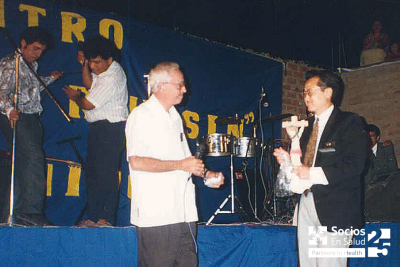
Dr. Jim Kim en la inauguración del auditorio Juan Roussin en el primer local de Socios En Salud en el AA.HH Raúl Porres Barrenechea, Carabayllo, Lima, 1996.
Carabayllo: Where It All Began
In the early 1990s, Carabayllo was a rapidly expanding district. Thousands of families had arrived from different regions of the country in search of opportunities in Lima. Urban growth was outpacing the expansion of public services, and access to medical care remained limited for a significant portion of the population.
It was in this context that tuberculosis found fertile ground.
Healthcare facilities treated cases every day, but some patients began to develop a much more complex form of the disease: MDR-TB, resistant to the drugs most commonly used at the time.
Father Jack Roussin, the local parish priest, knew this reality firsthand. For years, he supported families affected by the disease until he himself died as a result of MDR-TB. His death brought two young doctors to Carabayllo who had already been questioning the way the world responded to poverty-related diseases: Paul Farmer and Jim Yong Kim, co-founders of Partners In Health (PIH).
What they found confirmed that the problem was much broader than just a bacterium.
Some people abandoned treatment because they couldn’t afford transportation to a health center. Others stopped taking their medication so they could continue working and support their families. Some simply disappeared from the healthcare system.
The disease had a medical explanation. Its persistence also had a social explanation.

El doctor Paul Farmer en consulta con paciente, en 1997.
Foto de SES
One question changed the way tuberculosis was treated
Together with Peruvian physician Jaime Bayona and a small team of local professionals, Drs. Paul Farmer and Jim Yong Kim launched a pilot program that served just ten patients.
The approach seemed simple: in addition to offering the best available treatment, the team would try to eliminate all the barriers preventing patients from completing their treatment.
That meant visiting patients’ homes, getting to know their families, helping with transportation when necessary, providing food assistance, resolving everyday problems, and staying close to the patient throughout the entire process.
Over time, this practice would be given a name that is now part of Socios En Salud’s DNA: accompaniment.
It was not a complementary care strategy. It was at the heart of the model.
Dr. Paul Farmer used to say that “accompaniment” meant staying by a person’s side until they—and not the helper—felt that the journey was over. That definition summed up a different way of understanding medicine: treatment did not end with a prescription, but rather when the patient was truly able to regain their health.

El doctor Paul Farmer en el medio, rodeado de promotoras de la salud (así se les llamaba en aquel entonces a las agentes comunitarias de salud).
Foto de SES
Community health workers proved that closeness also saves lives
If there is a face that represents the story of Socios En Salud, it is probably not that of a researcher or a doctor.
It is the community health workers.
Elected by their own communities, they know the streets, the families, and the dynamics of their neighborhoods in a way that’s impossible to replicate from a doctor’s office. Thanks to that closeness, they could quickly identify when someone needed additional support to continue their treatment or when an absence masked a much bigger problem.
Their work helped transform the relationship between the healthcare system and communities that had long been marginalized.
Decades later, scientific evidence supported what they were already doing. A study published in 2024 in PLOS Global Public Health, conducted by researchers from Socios En Salud in collaboration with U.S. universities, found that people with tuberculosis achieve better outcomes when they receive support from family members or caregivers during treatment.
The research confirmed with data a conviction the team had developed through experience: adherence does not depend solely on the right medication, but also on the support network surrounding the patient.

En 1999, se llevó a cabo una celebración en Socios En Salud por el Día del Agente Comunitario.
Foto de SES
From Carabayllo to the World: When Evidence Changed the Rules
The program’s results began to attract attention because they challenged a widely accepted notion at the time: that multidrug-resistant tuberculosis was too expensive to treat successfully in low- and middle-income countries.
While other programs reported success rates of around 50%, the program developed by Socios En Salud achieved a cure rate of approximately 85%.
These results sparked new research.
In 2003, the Peruvian initiative made its way into the pages of The New England Journal of Medicine, one of the world’s most prestigious medical journals. From that point on, the collaboration with Harvard Medical School grew stronger and established Socios En Salud as a key player in international tuberculosis research.
Years later, this trajectory continued with studies such as endTB, whose findings contributed to the recommendations published by the WHO in 2024 for the treatment of multidrug-resistant tuberculosis.
What had begun as a local initiative ended up informing decisions that today guide patient care in various countries.

Los doctores Félix Alcántara y Jaime Bayona —primer director general de Socios En Salud— revisan radiografías de tórax durante los primeros años de trabajo de la organización.
Foto de SES
Much More Than Tuberculosis
Although tuberculosis marked the origins of Socios En Salud, the approach of patient accompaniment soon found new applications.
The organization expanded its work to include comprehensive HIV care, mental health, maternal, child, and adolescent health, as well as noncommunicable diseases and cancer.
The same principle continued to guide every program: the understanding that social determinants of health are just as influential as clinical diagnosis.
With this vision, initiatives such as the SES Polyclinic (POLSES), sheltered housing for people with chronic mental disorders, and research projects aimed at strengthening social support networks were launched, including the recent PASEO and DiME projects, which focus on HIV.
At the same time, the organization built scientific capacity through the SES Laboratory, strengthened partnerships with universities, international organizations, and the Peruvian government, and took on an increasingly important role in implementing programs funded by The Global Fund.

El doctor Leonid Lecca (izquierda), director general de Socios En Salud, participa en la inauguración del Laboratorio SES junto a un representante de Partners In Health, en noviembre de 2013.
Foto de SES
Thirty years later, the question remains the same
It is easy to summarize Socios En Salud’s history based on its awards, research, or indicators. All of these are important.
But perhaps the most profound legacy of these thirty years is something else.
The organization helped establish an idea that seems obvious today, though three decades ago it was considered disruptive: that a disease can never be understood in isolation from the conditions in which a person lives.
Access to transportation, food, housing, family support, and trust in the health care system are not secondary factors. They are part of the treatment.
At a time when health care systems face increasingly complex challenges, that conviction remains as relevant as ever.
The story of Socios En Salud demonstrates not only that a successful program can grow. It shows that an idea born in a community—when grounded in scientific evidence and a commitment to people—can ultimately transform the way the world understands health.