Citizen insecurity in Peru has escalated to critical levels. According to a recent report by the National Institute of Statistics and Informatics (INEI), around 85% of the urban population feels that they could be the victim of a crime in the coming months. This situation generates a strong impact on mental health, both individually and collectively.
“Among the most common reactions to this context are constant fear, a sense of vulnerability, chronic stress and even depressive symptoms,” says Margot Aguilar, a professional with the Mental Health (SAME) program of Socios En Salud (SES).
This scenario is corroborated by data from the Ministry of Health (MINSA), which records a sustained increase in anxiety disorders over the past five years, with higher incidence in peri-urban areas where crime is more prevalent.
According to MINSA, anxiety, insomnia and stress disorders are not random: up to four out of ten are linked to experiences of violence or constant fear of being a victim of crime. In cities marked by crime, young adults and women suffer most from the emotional consequences of living on alert.
This same reality is reflected in SES mental health interventions, where specialists report a notable increase in consultations for anxiety, panic attacks and sleep disturbances, especially in districts where the perception of criminal risk is higher. “At the community level, it can generate a climate of tension, distrust and isolation, which weakens social interaction,” Aguilar points out.
The Power of Community Accompaniment
In the face of this panorama, community accompaniment emerges as a fundamental tool for emotional recovery. SES, through its Mental Health program, promotes spaces where a group of people can share experiences, identify collective solutions and rebuild a sense of belonging.
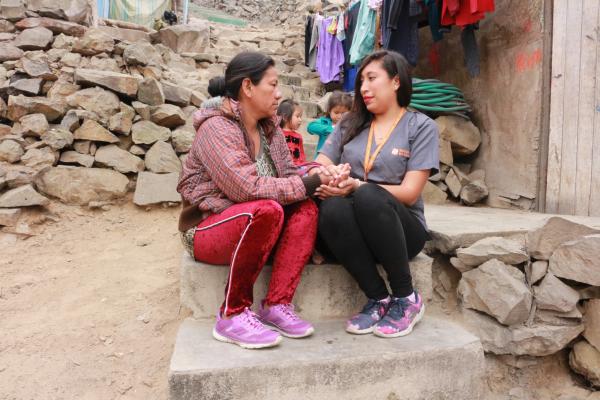
“When someone feels listened to and supported, their fear and anxiety decrease significantly,” Aguilar explains. Circles of support, home visits and community activities help rebuild trust and strengthen resilience. In these spaces, fear is transformed into dialogue, and isolation into bonding.
It is in these groups where the work of Community Health Agents (CHAs) is inserted, as they are people from the community and their participation is key. The ACS not only provide emotional support in homes, but also accompany people with mental health problems and provide accompaniment or link them to health services, ensuring care or continuity of care. This type of close, warm and constant accompaniment has been shown to reduce anxiety levels and encourage active seeking of professional help.
From the individual to the collective
An essential difference in the Partners In Health approach is the integration of community accompaniment in its interventions. While individual treatment focuses on each person’s symptoms, community accompaniment remains at their side throughout the process. As Paul Farmer pointed out, this accompaniment does not end when the professional decides, but when the person feels that he or she can cope with the difficulties on his or her own.
“We work with families, neighborhoods and local networks to strengthen mental health,” says the SAME program specialist. This perspective makes it possible to identify not only risk cases, but also opportunities for prevention, support networks and social reintegration, managing to emotionally sustain individuals and communities.
A very close example occurred with a group of pregnant mothers who are part of an SES project. Many of them were afraid to answer unknown calls for fear of extortion, which made it difficult for them to receive care. Thanks to the joint support of psychologists and community agents, they were able to regain their confidence, reconnect and participate in group activities. Today, these mothers have constant emotional support and mutual care networks.
Building emotional security from the community
Fighting citizen insecurity also involves strengthening emotional security. The work of Socios En Salud demonstrates that the answer is not only to strengthen surveillance or laws, but also to take care of the mental health of those who live in fear.
Community accompaniment does not eliminate crime, but it does reduce its psychological impact: it allows people to recognize one another, regain confidence and feel that they are not alone. In a context where uncertainty is a daily occurrence, accompanying - with empathy, presence and listening - can be the most transformative act.