In 1983, while the Cold War was ordering the world from afar, Haiti was facing another urgency. In Cange, a rural village without basic services, disease accompanied daily life. Tuberculosis was circulating unchecked and medical care was scarce. In that territory marked by neglect began a story that decades later would give rise to Socios En Salud (SES).
That year, Dr. Paul Farmer and Ophelia Dahl arrived in Haiti from Boston (USA). Farmer was 23 years old and not yet in medical school. It was his first trip outside North America. In addition to health precariousness, the doctor encountered a moral question that would define his life and his understanding of medicine.
The clinic they set up was simple and built with community support. It offered free care and operated under a different logic than usual. Closeness, constancy and sustained commitment marked that first effort. Over time, that experience became the basis for a health model focused on equity.
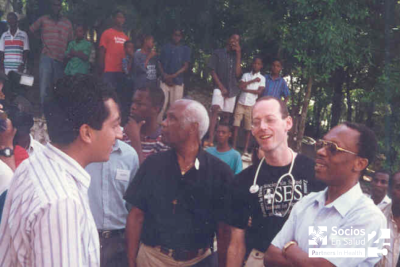
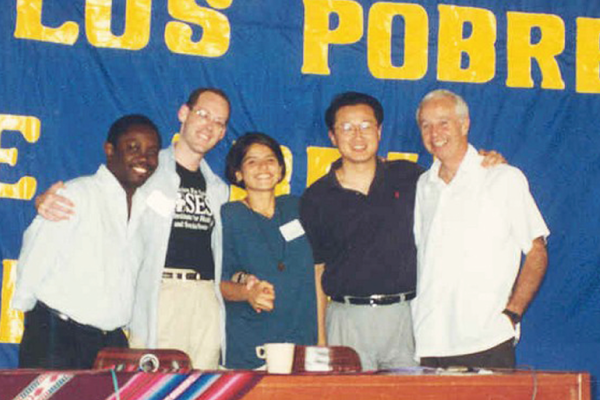
Dres. Paul Farmer y Jaime Bayona en Haití, 1996.
From Haiti to the world: the beginning of a model in global health
Over the years, Drs. Jim Kim, Todd McCormack and Thomas J. White joined the work begun in Haiti. Thus took shape Partners In Health (PIH), an international nonprofit organization that placed social justice at the center of health care. Its proposal challenged the idea that quality inevitably depended on available resources.
In Haiti, the team demonstrated that diseases considered untreatable could be addressed with community accompaniment and continuity. Medical care ceased to be a one-time event and became a sustained relationship. This experience aroused the interest of universities, hospitals and international organizations.
What was learned in Cange made it possible to think about public health from a different perspective. The disease ceased to be seen as an isolated episode and began to be understood within a broader social context. This perspective was decisive when, in the mid-1990s, PIH began its work in Peru.
Peru and tuberculosis: the origin of Partners In Health
In 1995, Father Jack Roussin was the driving force behind Partners In Health’s arrival in Lima. He settled in Carabayllo, an area hit by tuberculosis (TB). Although Peru was listed by the World Health Organization (WHO) as a benchmark in TB control, the disease persisted in the territory among people who had accumulated years of treatment.
The situation became personal when Roussin fell ill and died of multidrug-resistant tuberculosis (MDR-TB). His passing shook Drs. Farmer and Kim. MDR-TB exposed a structural failure of the system and a deep gap between formal protocols and the daily lives of communities.
Peruvian physician Jaime Bayona joined the work and established contact with Dr. Kim. Inspired by the Haiti experience, they began to train community health workers who accompanied people throughout the treatment. This is how on July 8, 1996, Socios En Salud was born as a direct response to that crisis.
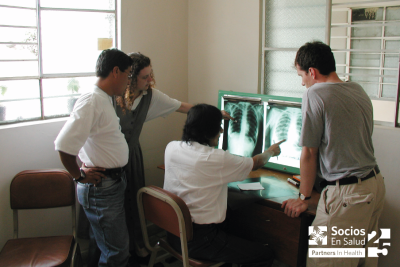
Primeros estudios de tuberculosis multirresistente liderado por Socios En Salud, Perú.
Community Accompaniment and a Legacy that Turns 30
The first studies led by Socios En Salud identified an outbreak of multidrug-resistant tuberculosis in Carabayllo. More than 50 cases in a population of 100,000 people. Medications were unaffordable. For many, diagnosis was tantamount to condemnation.
The SES team decided not to accept that horizon. With community support and international networks, it proved that multidrug-resistant TB could be treated. “Everything was stacked against us,” Dr. Jim Kim once recalled. “It was a life-or-death situation.”
For years, community agents accompanied every stage of treatment. Care included clinical, emotional, nutritional and social support. Seventy-five people were cured. That result led the WHO to revise its protocols and consolidated Socios En Salud as a global benchmark.
Thirty years later, Socios En Salud maintains the conviction that marked its origins. Health is built in company, with sustained presence and real commitment. From Haiti to Peru, that principle continues to guide a practice that turned social justice into a concrete way to save lives.