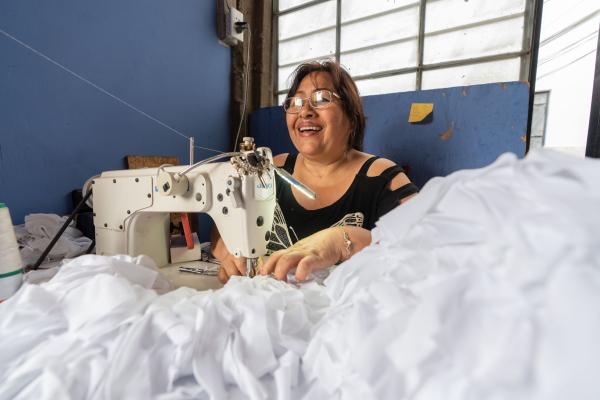
“I cried with emotion. The doctor told me, ‘Ma’am, there is no cancer in your body, but you’re going to keep coming to the hospital.’ I didn’t quite understand. Later, someone from Socios En Salud (SES) explained me better. He told me that he had cleared her, that she was in remission, but that she would keep going for checkups.”
María Soledad Romero repeats the phrase carefully, as if she still needs to verify that it is true. She is 53 years old and lives on Avenida Túpac Amaru, in Comas, a district north of Lima where she arrived when she was barely two months old, when her mother left Rimac and settled on a newly occupied plot of land. Since then, she has not moved from there.
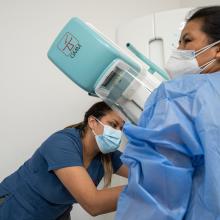
In the same district remains the Centro Materno Infantil Santa Luzmila II. In 2022, the ALMA project, designed by the Noncommunicable Diseases (NCDs) and Cancer program of SES, and DIRIS Lima Norte, offered free breast cancer screenings at that facility - and two others in northern Lima - to more than 1,800 women who had never accessed a screening. Romero was one of them.
The result confirmed the presence of breast cancer. She remembers that moment as an interruption: life was still happening and, suddenly, something snapped.
“A lot of things went through my head,” she says. “I have a son, three grandchildren. At that moment I thought about them. More than about me, I thought about them.”
She was referred to the National Institute of Neoplastic Diseases (INEN). As the system began to kick in - appointments, paperwork, dates she still didn’t fully understand - Romero was trying to assimilate news that didn’t come with clear instructions on how to get through it.
In time, her journey would take on a meaning that went beyond her own story. “Maria is the first person to achieve remission within this intervention,” explains Santiago Palomino, head of SES’s ENT and Cancer program. “The project, at some point, had to change direction (not just offer discarding) and today follows up women already diagnosed with breast cancer.”
The project, at some point, had to change direction (not just offer discarding) and today follows up women already diagnosed with breast cancer.
For Romero, however, at the time none of that was visible. The process was just beginning. And although she didn’t know it yet, from that point on she would not be alone.
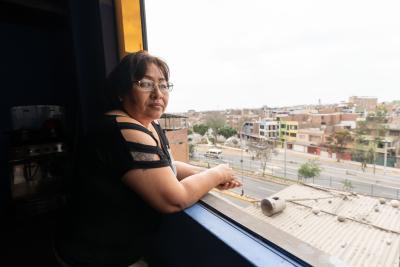
María Soledad Romero consiguió superar el cáncer de mama luego de ser diagnosticada con esta enfermedad en octubre de 2022.
Foto de Diego Diaz / SES
The first accompaniment
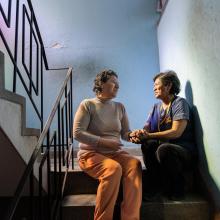
María Rosas, a community health agent with the ENT and Cancer program, remembers Romero not by a date, but by a journey. The first time they left for INEN to secure an appointment was in the early morning. At four o’clock in the morning, the car sent by SES came to pick her up at her home in Comas.
“We had to be at INEN at six in the morning to reach a slot so she could get in and get her appointment through the office,” she says.
For Rosas, the support begins long before treatment. It begins in the attempt to reduce confusion. Conversation, in that context, means explaining the concrete: where to sit, what documents to hand over, who to observe.
“I tell them: you watch where I move,” he says. “I’m going to leave the papers (at INEN), to do the paperwork. Little by little they are understanding how everything works.”
Rosas knows that the first contact is often difficult. The women arrive with the recent weight of the diagnosis, sometimes at a loss for words. “You don’t always know what to say,” she admits. “They’re depressed about the results.” At those times, the job is to be available: give the phone number, repeat directions, call back.
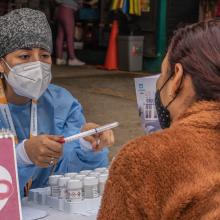
That daily grind - made up of repeated transfers, calls and explanations - is not exceptional. Last year alone, SES screened 496 women for breast cancer in northern Lima. Of these, 372 received continuous care and accompaniment throughout their diagnostic and therapeutic process. Romero was one of those stories followed step by step.
Breast cancer: detect early, accompany better
In Peru, breast cancer is the most frequent neoplasm among women. Each year more than 7,000 new cases are diagnosed and around 2,000 women die from this disease. However, the Ministry of Health (MINSA) points out that, when detected early, the probability of cure can reach 90%.
Romero had seen friends die from different types of cancer, almost always after arriving late for a screening. Upon receiving her diagnosis, those images came back with a vengeance: weakened bodies, hair falling out, pain that seemed to have no respite. For several days, the future presented itself to her as a succession of scenes she didn’t want to star in.
But after that first blow, he began to sort out the immediate. “You have to get out of this, I told myself,” he says. That’s when she understood that she wasn’t going to be able to go through the process alone. There was her family, her partner and also an accompaniment that was not limited to medical treatment. That is one of the axes of the SES intervention.
”To date, we are providing support in the clinical navigation of 20 women with breast cancer,” explains Diana Huamán, coordinator of the ALMA project. “The support consists of offering psychological therapies and social protection to alleviate the enormous burden of dealing with this disease.”
The chemotherapy did not go as Romero had imagined. Except for the last one that took her to the emergency room for severe joint pain, she was able to continue working as a seamstress. She received the chemo, rested for two days and returned to her routine. While it was not the end of the process, it no longer resembled the beginning.
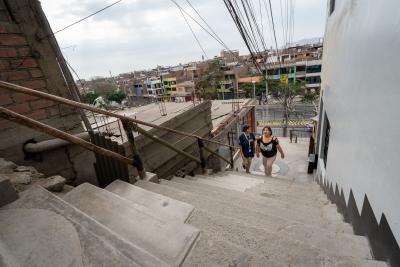
En el último año, alrededor de 120 visitas realizaron las agentes comunitarias de salud de SES a mujeres con cáncer de mama.
Foto de Diego Diaz / SES
The difference of being
If anything distinguishes María Soledad Romero’s memory of her treatment, it is not a date or a procedure, but a presence. The calls. The messages. The visits that didn’t need an excuse. “I felt like I wasn’t alone,” she says. “I felt like I had more family than I already had.”
That way of being is echoed in other stories. In 2025, SES community agents made 118 visits to women with breast cancer. Not all left a visible mark, but many prevented a dropout. That same year, 22 women diagnosed managed to sustain their treatment.
Romero witnesses the weight of not going through the process in isolation. “I saw it much easier,” she says. Not because the treatment was mild, but because she didn’t walk it alone. That’s why, when asked what was as important as the chemotherapy or the doctor’s appointments, she talks about the support. Of the people who were there.
For her, being accompanied transforms the journey. It doesn’t make it easy. But it makes it possible.