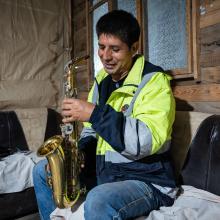
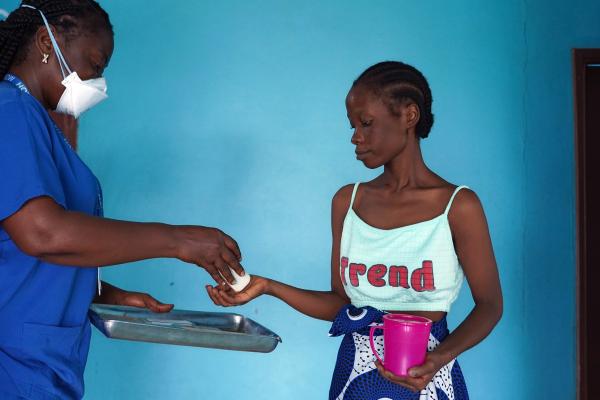
In 2021, Elvis Espinosa was diagnosed with multidrug-resistant tuberculosis (MDR-TB) and warned by his healthcare team in Peru that the road ahead would not be easy. His treatment consisted of a routine of up to 16 pills a day, accompanied by painful injections. Even after months of disciplined compliance with this regimen, Espinosa felt no relief and was losing weight rapidly: he dropped from his usual weight of 83 kilos to just 43.
Espinosa’s disease had progressed to an even more complex form of tuberculosis (TB), pre-extensively drug-resistant TB (pre-TB XDR), resistant to several additional drugs, and he began to lose hope. He returned to his birthplace-La Oroya-with his family to say goodbye to the place where he grew up, thinking he would soon die.
Then, a Partners In Health initiative changed everything.
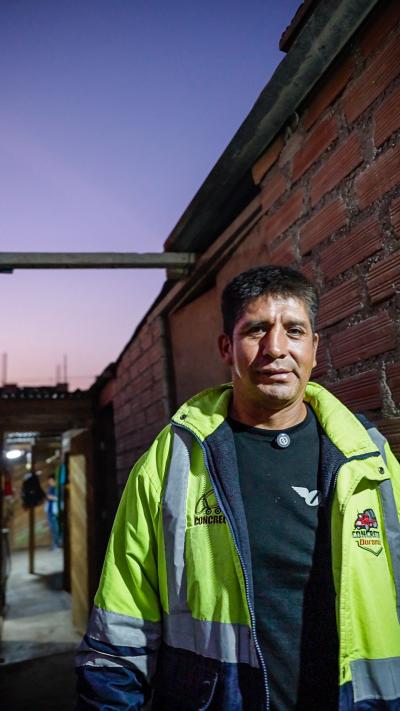
Elvis Espinosa fue uno de los 324 participantes que participaron en el ensayo clínico endTB-Q, centrado en mejorar los tratamientos contra la tuberculosis pre-XDR.
Foto de Diego Diaz / SES
An innovative approach to TB treatment
At the height of his illness, the Socios En Salud team found him at a local health center, reviewed his TB history and proposed a new treatment plan. He would only have to take four pills a day-an all-oral, revolutionary scheme recommended by PIH-led research.
The six- to nine-month regimen with four all-oral drugs -bedaquiline, delamanid, linezolid and clofazimine - proved to be a shorter, safer and more tolerable treatment for the most resistant form of TB, compared with the standard treatment of up to 18 months with injectables and serious adverse effects that had not helped Espinosa.
With each month of the new regimen, her body finally began to recover. Around the world, clinical teams were seeing similar results in people with drug-resistant tuberculosis (MDR-TB).
To build on the success of this improved treatment in people like Espinosa and accelerate its implementation in high-burden TB countries, Partners In Health and Unitaid launched the Accelerating regimens and care for MDR-TB (arcTB) project to strengthen diagnosis, prevention and treatment in Belarus, the Democratic Republic of Congo, Kazakhstan, Liberia, Pakistan, Peru and South Africa.
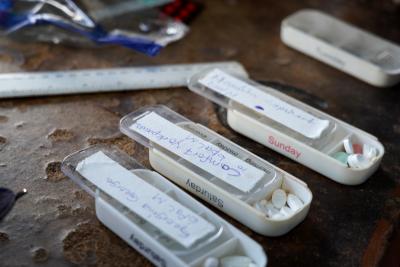
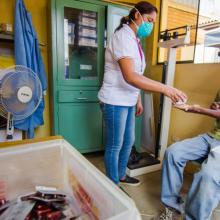
El nuevo régimen para tratar la tuberculosis resistente consiste en la ingesta de solo pastillas durante un periodo de hasta nueve meses.
Foto de Aminata K. Massaley / PIH
The arcTB project
With funding of $7,3 million from Unitaid - an organization with a strong commitment to driving innovation in the fight against MDR-TB - arcTB is led by PIH in collaboration with a consortium of global health partners. Médecins Sans Frontières, IRD Global and the University of Stellenbosch are consortium partners in implementing this initiative, providing people-centered care in the seven high-burden countries. Programmatic and diagnostic capacity will be bolstered by technical expertise from Harvard Medical School and the Antwerp Institute of Tropical Medicine, supporting the implementation of the latest WHO-recommended tools and strategies for MDR-TB care.
Despite being preventable and curable, tuberculosis remains the world’s deadliest infectious disease, causing the deaths of 1.3 million people each year. Alarmingly, only one in four people with MDR-TB is diagnosed and successfully treated, underscoring the need for investments like arcTB.
Over the next three years, arcTB will strengthen case detection, connect people to preventive and curative services, and improve the quality and availability of treatment, especially for girls, children and pregnant women. In arcTB, all people diagnosed with active MDR-TB will be offered the latest all-oral treatments Espinosa received.
“Too many people miss out at every point in the cascade of care-from recognizing symptoms to accessing testing and receiving appropriate treatment,” said Dr. Michael Rich, senior health and policy advisor at PIH. “arcTB seeks to break down those barriers-bringing testing closer to communities, simplifying treatment, and ensuring that care is not only available, but compassionate and comprehensive. When countries achieve this, TB can decline by more than 10% per year. That’s not just progress: it’s the path to elimination.”
Already, Partners In Health teams in Kazakhstan, Liberia and Peru have begun planning with local partners and ministries of health to implement the work outlined in arcTB. As the project continues to grow in the coming years, advances in TB treatment will reach those who need them most around the world.
arcTB builds on PIH’s legacy of innovative care for MDR-TB, from its pioneering work in the barrios of Lima in the 1990s to its leadership in developing new and improved regimens in the 2020s. arcTB marks the next step in PIH’s mission to ensure that impoverished and marginalized people around the world-like Elvis Espinosa-have access to the best TB care, bringing us closer to a world free of TB.